Nervous cats reject fountains that make unexpected sounds or sudden movements. We break down the exact noise and design factors that determine whether a skittish cat will accept a fountain.
Why Nervous Cats Reject Fountains (And It’s Not Just About Noise)
Most guides focus on decibel levels. That matters, but it’s not the complete picture. Nervous cats reject fountains for three distinct reasons, and a fountain that solves only one of them won’t succeed:
1. Unexpected motor sound at startup: Most fountains cycle on and off as temperature fluctuates. A cat that associates the area with food or safety can be startled when the motor starts unexpectedly. Constant-run motors eliminate this.
2. Vibration transmitted through the surface: A motor that’s “quiet” in terms of airborne sound can still vibrate a tile floor noticeably. Cats feel vibration through their paws acutely. A quiet fountain on a wooden floor may actually be less acceptable than a slightly louder fountain on a vibration-absorbing mat.
3. Water movement pattern: Nervous cats prefer predictable, consistent flow. A fountain with cascading jets that change pattern as the water level changes creates unpredictability. Simple streams or gentle bubble modes are more acceptable to anxious cats.
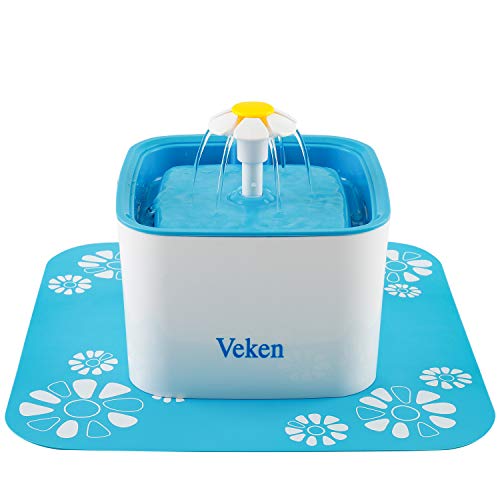
Veken Pet Fountain 84oz/2.5L Automatic Cat Water Fountain with 3 Replacement Filters & 1 Silicone Mat
What to Measure (Not Just “Quiet”)
When evaluating a fountain for a nervous cat, assess these four things:
Motor run pattern: Constant-run vs. thermostatic cycling. Constant-run means the motor never unexpectedly starts and stops. This eliminates the startle response that cycling motors cause. Most quality fountains with brushless DC motors are constant-run.
Airborne noise level (dB): Anything under 30dB is genuinely quiet — quieter than a normal conversation whisper. Between 30–40dB is acceptable for most nervous cats if the motor is constant-run. Above 40dB will cause consistent avoidance in genuinely anxious cats.
Vibration isolation: Does the fountain sit flush on a hard surface, or does it have rubber feet? Rubber feet significantly reduce vibration transmission. If a fountain you like doesn’t have rubber feet, placing a thick silicone mat or folded towel underneath achieves the same effect.
Flow predictability: Does the flow pattern change as the water level changes? Better fountains maintain consistent flow until the reservoir is nearly empty. Budget fountains often have a pump that becomes audible and changes flow pattern when running low — this creates unpredictability exactly when you’re most likely to forget to refill.
Fountain Types Ranked for Nervous Cats
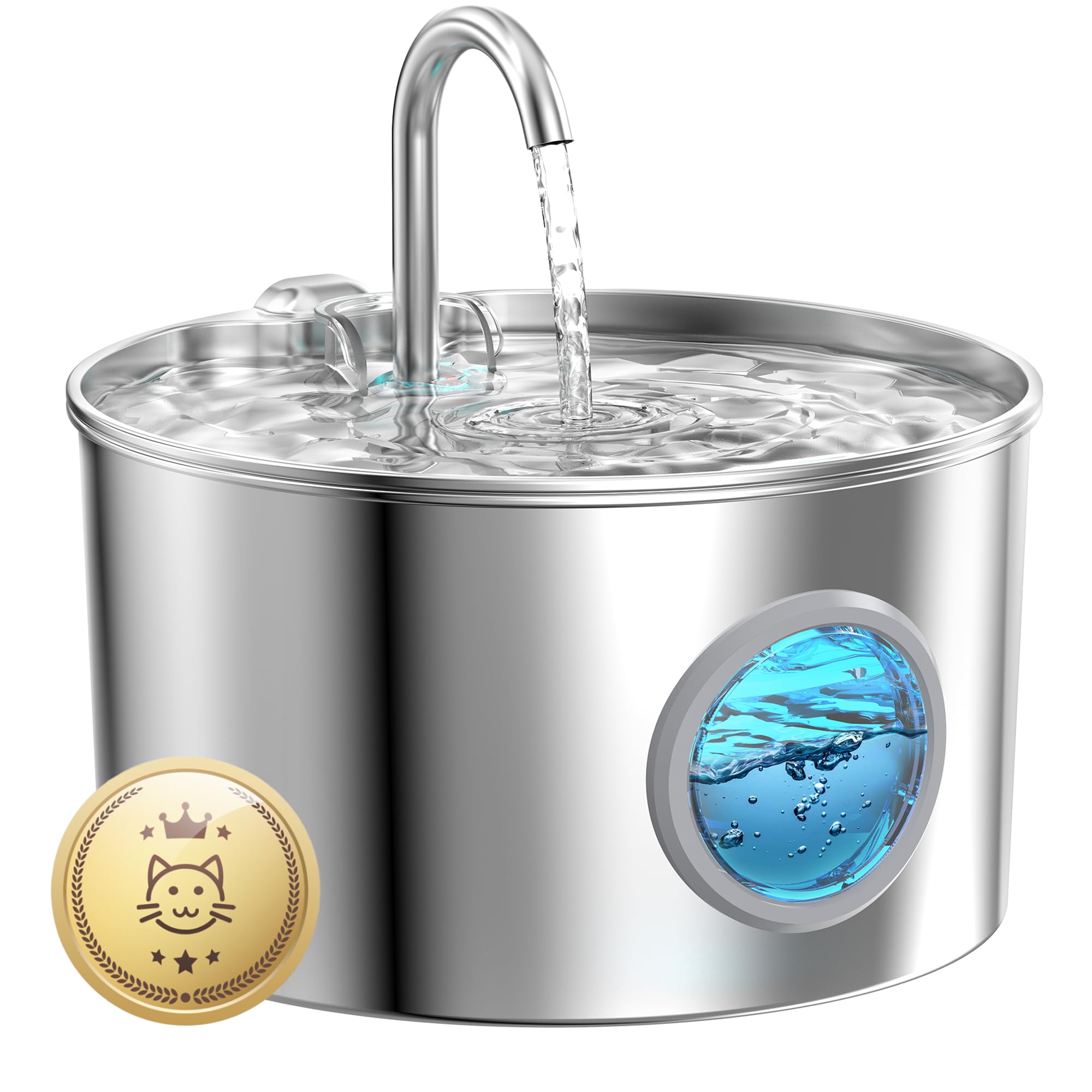
Best: Stainless Steel Fountains with Brushless DC Motor
Stainless steel is acoustically denser than plastic — it resonates less when the motor runs. A brushless DC motor in a stainless housing is the quietest combination available.
Additionally, stainless steel fountains tend to be heavier, which naturally reduces vibration movement on a surface.
The tradeoff: higher cost. For a nervous cat, this is usually worthwhile — a cheaper fountain a skittish cat refuses is a more expensive mistake.
See stainless steel fountain rankings
Good: Filtered Plastic Fountains with Rubber Feet
Many mid-range plastic fountains with brushless DC motors and rubber feet perform well for nervous cats. The key specs to confirm: stated dB level under 35, rubber or silicone feet, and a constant-run motor description.
See filtered fountain rankings
Avoid: Fountains with Multiple Flow Mode Buttons
Multi-mode fountains (stream + cascade + bubble) require a button press to change modes — this means they’re likely to be switched accidentally, creating unexpected sound changes. For a nervous cat, predictability is paramount. Simple single-mode or user-preset mode fountains are more reliable for anxiety management.
Introduction Technique for Nervous Cats
The fountain itself is only half the equation. How you introduce it matters equally.
Don’t turn it on immediately: Place the fountain in your cat’s space unpowered for 2–3 days. Let them investigate, sniff, and rub against it. When it’s just a new object (not a new noise), it becomes familiar before it becomes active.
Introduce sound gradually: Some fountains have a flow rate adjustment. Start at the minimum flow setting for the first week. The sound is softer, the water movement is gentler, and the cat has time to classify it as background noise rather than threat.
Place it where they feel safe, not where you think is convenient: The “correct” spot for water dispensing isn’t always where your nervous cat is comfortable eating or sleeping. A nervous cat will not approach a fountain in a high-traffic area, even if the fountain is silent. The cat’s perceived safety zone wins over your layout preferences.
Don’t move it after placement: Nervous cats map their territory carefully. Moving the fountain — even one foot — can trigger a reset of the acceptance process.
Signs Your Cat Is Accepting the Fountain
- Approaches and sniffs without retreating immediately
- Sits near the fountain without tension in body posture
- Drinks from it even when you’re in the same room
Signs Your Cat Is Rejecting the Fountain
- Avoids the room where the fountain is located
- Drinks from the old bowl but won’t approach the fountain
- Approaches, startles at the motor sound, and retreats repeatedly
If you see rejection behavior after 3 weeks of patient introduction, try: (1) relocating to a quieter area, (2) adding a vibration-absorbing mat, (3) switching to a different flow mode, or (4) the fountain may genuinely be too loud for your specific cat — a stainless steel model with documented lower dB may be necessary.
Frequently Asked Questions
My cat was fine with the fountain for 3 months, then stopped using it. Why?
The most common cause: the pump has accumulated mineral deposits and become louder. Descale the pump with diluted white vinegar (follow manufacturer instructions), rinse thoroughly, and the sound should return to original levels. Alternatively, the carbon filter is exhausted and the water has developed an off-taste.
Will a cat ever get used to a loud fountain?
Some cats do habituate over 4–6 weeks. Nervous cats are less likely to. The risk of waiting for habituation is that your cat avoids the fountain entirely during the adjustment period, leading to reduced hydration. It’s safer to start with a quieter model than to assume adaptation will happen.
My cat drinks only from the fountain stream (not the basin). Does that matter?
No — the cat is drinking, which is the goal. Stream drinking is common for cats who prefer moving water. If the stream position changes as the water level drops, refill more frequently to keep the stream consistent.
Should I get a fountain with a lid to reduce evaporation and noise?
Covered fountains do reduce some water loss, but the acoustic difference is minimal — sound travels around a lid easily. The main benefit of a covered fountain is keeping dust and debris out of the water, which extends filter life.
For full fountain rankings organized by noise level and motor type: Filtered Fountains or Stainless Steel Fountains.
This post contains affiliate links. We may earn a commission when you purchase through our links at no extra cost to you.