Data-driven buying guide drawn from our ranked catalog of 309,000+ Amazon customer ratings. Learn what features matter and avoid common mistakes.
Multi Pet Feeder: A Practical Guide for 2026
Multi Pet Feeders are automatic feeding stations designed to dispense food for multiple pets, either through separate compartments or by recognizing individual pets via microchip or RFID technology. They work best for households with two or more cats or small dogs that need separate portions, different food types, or scheduled feeding times. Based on our analysis of the ranked catalog (309,000+ Amazon customer ratings as of September 2026), the top models share three key traits: reliable portion control, sturdy construction that resists pet tampering, and straightforward programming without smartphone app glitches.
What Is a Multi Pet Feeder?
A multi pet feeder is an automatic feeding device that can serve more than one animal. There are two main types: compartment-style feeders that rotate to reveal different food bowls at set times, and microchip-activated feeders that open only for a specific pet wearing a registered tag. The first type is simpler and cheaper—it splits a single food hopper into portions, dispensing them across the day for one pet or allowing two pets to eat from separate bowls. The second type is more sophisticated: it uses RFID sensors to read your pet’s microchip or collar tag, keeping other animals out of that pet’s food.
These feeders solve a real problem in multi-pet homes: one pet eating another’s food, either because they’re faster, pushier, or simply hungrier. They also help with medication timing, weight management, and feeding different diets (e.g., one pet on prescription food, another on standard kibble).
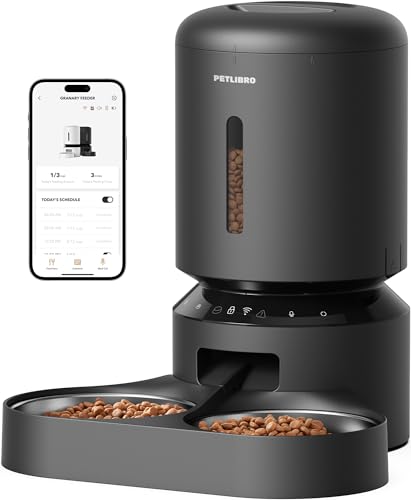
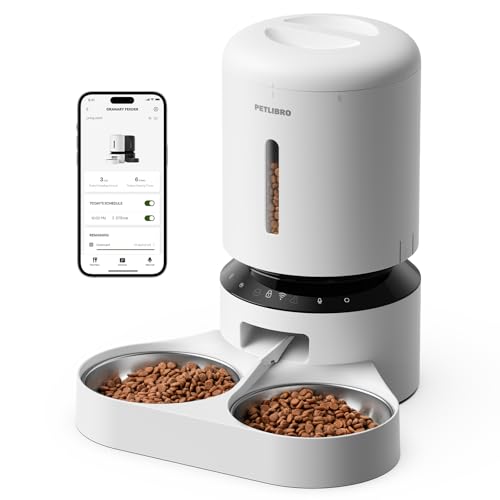
PETLIBRO Automatic Cat Feeder for 2 Cats, 5L Granary Dual Bowl Auto Cat Food Dispenser
Who Should Get One?
You should consider a multi pet feeder if you have two or more pets and any of these apply:
- One pet needs a specific diet (weight loss food, urinary health formula, or medication mixed into meals)
- One pet eats too fast and steals from the other’s bowl
- You work long or irregular hours and cannot supervise meal times
- Your pets have different feeding schedules (e.g., one eats twice daily, another grazes)
- You want to automate portion control to prevent overfeeding
Single-pet households generally don’t need a multi pet feeder—a standard automatic feeder will suffice. Likewise, if your pets already eat peacefully side-by-side with the same food, a basic feeder with a larger capacity may be more practical.
Key Specs to Compare
-
Pet Recognition Technology: Microchip vs. RFID collar tag. Microchip-based feeders read your pet’s implanted chip, which can’t be lost. RFID tag feeders are cheaper but require the pet to wear a tag. Both work, but microchip models are more reliable long-term. Reviewers commonly report that collar tags fall off or get chewed.
-
Bowl Capacity and Configuration: Number of bowls and their size. Two-bowl models are standard, but some offer three or four. Larger bowls (1-2 cups each) matter for bigger pets or if you’re away for extended periods. Check whether bowls are dishwasher-safe—stainless steel is best for hygiene.
-
Portion Control Precision: Minimum serving size (usually 1/8 cup increments) and maximum per meal. Finicky eaters need smaller increments. Models with adjustable portion settings allow you to fine-tune meals for each pet individually.
-
Power Source and Backup: Battery operation vs. AC adapter, plus backup battery compartment for power outages. Many feeders require both to function properly. Reviewers report that feeders with built-in battery backup (not just a battery compartment for programming) handle outages better.
-
Programming Interface: Physical buttons vs. app control. Physical buttons are more reliable day-to-day—apps can crash, require updates, or lose connection. However, app-controlled feeders offer scheduling flexibility and feeding logs. Look for models that work without the app after initial setup.
-
Tamper Resistance: Lid locks, weight sensors, or anti-scratch surfaces. Multi-pet households often have one clever pet that learns to open lids or knock over the feeder. Models with locking mechanisms or weighted bases score higher in reviews for durability.
What to Avoid
Avoid feeders that rely solely on smartphone apps for basic functions. If the app goes down, you lose scheduling and manual dispensing. Choose models with physical buttons for primary controls, even if they also offer app connectivity. Reviewers frequently mention frustration when apps fail during vacations or business trips.
Avoid feeders with plastic bowls if you have pets prone to chin acne or allergies. Stainless steel or ceramic bowls are easier to clean and less likely to harbor bacteria. Plastic bowls can develop scratches that trap food residue and bacteria, causing skin issues in sensitive pets.
Avoid “one size fits all” portion settings. If your pets have different dietary needs, a single-hopper feeder that just divides portions equally won’t work. You need a feeder with separate compartments or individual recognition that lets you set different amounts per pet.
Frequently Asked Questions
Can I use a multi pet feeder for both cats and dogs?
Yes, but with caveats. The feeder must be sturdy enough to withstand a dog’s force if they try to push or paw at it. Microchip feeders work for both species, but dogs with larger heads may have trouble fitting into smaller feeding compartments. Check the bowl opening size before purchasing.
Will my pet’s existing microchip work with these feeders?
Most microchip-activated feeders read ISO standard 11784/11785 microchips, which are common in the US and Europe. However, some older or non-standard chips (like Avid) may not be recognized. Check the manufacturer’s compatibility list before buying. If your pet isn’t microchipped, RFID collar tags are a reliable alternative.
How often do I need to clean a multi pet feeder?
At least weekly for the food hopper and bowls, and monthly for the rotating mechanism (if compartment-style). Food residue can attract pests and grow mold. Stainless steel bowls should be washed with hot soapy water; plastic parts should be hand-washed to avoid scratches. Reviewers report that neglected feeders develop clogs and odor issues within two months.
Can I feed wet food in a multi pet feeder?
Some models support wet food, but it’s risky. Wet food spoils quickly (within 4-6 hours at room temperature) and can create bacterial growth in the hopper. If you must use wet food, choose a feeder with a cooling compartment or one that dispenses into a sealed, refrigerated bowl. Most reviewers recommend sticking to dry kibble for automatic feeders.
For a broader overview of automatic feeders, see our rankings of the best automatic feeders for 2026. If you’re deciding between microchip and compartment-style models, our comparison guide of microchip vs. compartment feeders breaks down the tradeoffs. For more on setting up feeding schedules, read our guide to programming multi pet feeders.
This post contains affiliate links. We may earn a commission when you purchase through our links at no extra cost to you.