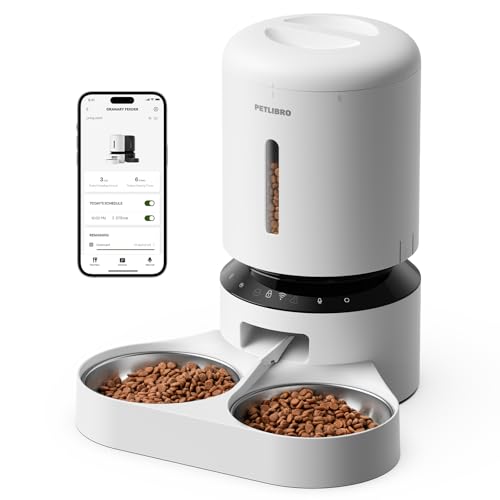
When cats need different portion sizes — due to age, weight, or health conditions — a single shared feeder fails. We explain the three hardware solutions that actually work for multi-cat differential feeding.
The Multi-Cat Feeding Problem
In a multi-cat household, one shared bowl almost always means the dominant cat eats more than their share. The solution isn’t discipline — cats establish feeding hierarchies instinctively. The solution is hardware that enforces separation at the access level.
The scenarios this guide addresses:
- Cat A needs 1/3 cup; Cat B needs 1/2 cup (weight difference)
- Cat A is on a prescription kidney diet; Cat B eats regular kibble (medical difference)
- Cat A is a senior with slower metabolism; Cat B is a kitten needing growth nutrition
- One cat eats too fast and steals from the other
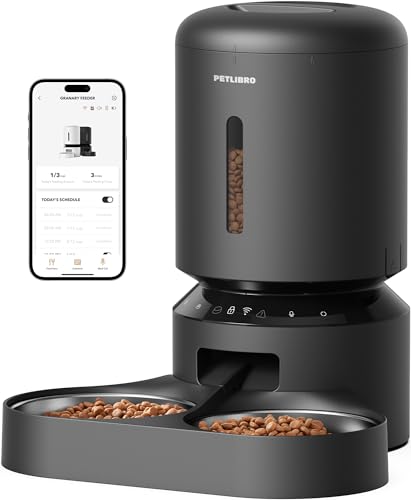
PETLIBRO Automatic Cat Feeder for 2 Cats, 5L Granary Dual Bowl Auto Cat Food Dispenser
Three Hardware Solutions, Ranked by Effectiveness
Solution 1: Microchip-Activated Individual Feeders (Most Reliable)
Each cat gets their own feeder that opens only for their microchip or RFID collar tag. No other cat can access that feeder’s bowl.
How it works: The feeder lid closes when an unrecognized chip comes within range. The correct cat approaches, the lid opens, they eat. Another cat approaches — lid closes or remains closed.
What you need: One feeder per cat, each programmed to the correct microchip. Each feeder can hold a different food type and dispense different quantities.
The limitation: Some cats figure out how to eat from the side when another cat opens a lid nearby. Feeders with deeper lid coverage or side shields perform better for bold “food thieves.”
For cats with existing microchips (most cats), you just hold the chip near the sensor during setup — no additional collar hardware needed.
See multi-pet feeder rankings for options with microchip activation
Solution 2: Two Separate Feeders in Different Rooms
The simplest solution, requiring no specialized hardware: place each feeder in a different room and close the door while cats eat.
Why this works better than expected: Most cats naturally have feeding territories. Once established, a cat will reliably return to “their” room at meal times, especially if the schedule is consistent.
Implementation: Program both feeders for the same meal times. At feeding time, separate the cats (many do this naturally), let them eat, then reopen the common areas after 15 minutes.
The limitation: Requires you to manage the door for unattended meals unless the rooms have automatic doors or cat flaps with RFID access control.
Two-feeder setup using timed feeders
Solution 3: Multi-Station Feeders with Separate Compartments
Some feeders are designed explicitly for 2-cat households, with two physically separated dispensing stations, each programmable independently.
The appeal: One device, two configurations. Each station can dispense a different quantity on a different schedule. The stations are positioned far enough apart that simultaneous feeding doesn’t cause competition.
The limitation: Compartmentalized multi-pet feeders don’t prevent a determined dominant cat from moving between stations. They work best when cats have a relaxed feeding dynamic — where the problem is simply different portion needs, not active food theft.
Medical Diet Situations: The Prescription Food Problem
When one cat eats prescription food and the other eats regular kibble, cross-eating becomes a health issue, not just a fairness issue.
In this scenario, microchip-activated feeders are the only reliable solution. The bowl containing prescription food must be physically inaccessible to the wrong cat — not just separated in space, because cats will investigate each other’s bowls.
Additional setup for medical diets:
- Program the prescription feeder for the medical cat’s microchip only
- Place the regular food feeder in a separate room with the door kept closed, or use a microchip feeder for both cats (each opening only for the correct chip)
- Confirm your cats’ microchip numbers with your vet — some older microchips use frequencies that may not be compatible with all feeders
Common Multi-Cat Scenarios and Recommended Approaches
| Scenario | Recommended Solution |
|---|---|
| Different amounts, similar food, relaxed cats | Two separate feeders, different rooms |
| Different amounts, dominant cat steals | Microchip feeders, one per cat |
| Different food types (not medical) | Two feeders, different rooms with managed separation |
| Prescription diet for one cat | Microchip feeders (required) |
| Kitten + adult different nutritional needs | Microchip feeders or height separation (kittens can’t reach elevated feeders) |
Height as a Separation Tool for Kitten + Adult Households
A technique that works surprisingly well for kitten-plus-adult homes: place the adult cat’s feeder on a counter or elevated shelf the kitten can’t reach, and the kitten’s feeder on the floor.
Adult cats can access either location; kittens can’t reach elevated surfaces. This provides natural separation without hardware investment.
This works until the kitten is approximately 4–5 months old and begins jumping. At that point, microchip feeders or room separation become necessary.
Frequently Asked Questions
My cats eat from each other’s bowls no matter what I do. What’s left?
The definitive solution is microchip-activated feeders with a lid deep enough that a cat can’t reach in from the side. Look for models with a recessed bowl design (the bowl is below the rim level of the enclosure) rather than a flat lid — recessed access physically prevents side-reach.
Can I program two microchip feeders to the same chip?
No — each feeder opens for one registered chip only. If both cats have chips and you want both to have restricted access, you need two feeders, each registered to its respective cat.
My cats are bonded and get stressed when separated to eat. What should I do?
Try a shared feeding station with two bowls but use portioned feeders that release the correct amount at the correct time — the cats eat together, but each bowl releases only the portion for that meal. The competition happens over already-portioned amounts, which limits over-eating even if one cat eats slightly faster.
Does a multi-pet feeder work for cats AND a dog?
Only if the dog is trained not to approach the cat feeder, or if you use a microchip feeder that distinguishes between species by chip frequency. Most microchip cat feeders don’t register dog microchips — the chip types are usually compatible, but confirm with the manufacturer before purchasing.
See full rankings for multi-pet feeders including microchip compatibility details, or compare how to feed multiple cats automatically vs. a standard single feeder.
This post contains affiliate links. We may earn a commission when you purchase through our links at no extra cost to you.