Both gravity feeders and automatic timed feeders dispense dry cat food — but they solve completely different problems. Here's a data-backed comparison to help you choose the right type for your cat.

The Core Difference
A gravity feeder and an automatic timed feeder do fundamentally different things:
Gravity feeder: Dispenses food continuously by gravity as the bowl empties. There is always food available. The cat eats whenever they want, however much they want.
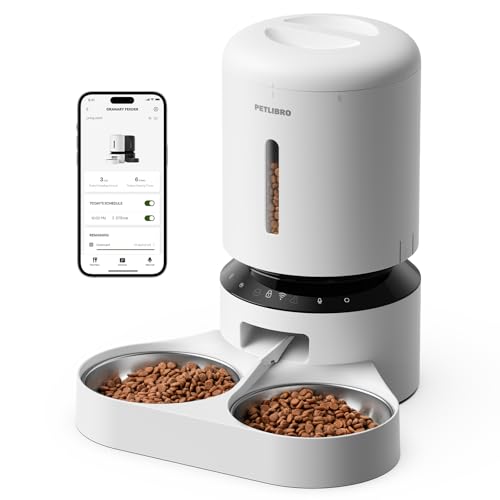
Automatic timed feeder: Dispenses a specific amount at a specific time. Between scheduled meals, the bowl is empty. The cat eats only what’s been programmed.
This isn’t just a technical difference — it’s a feeding philosophy difference. Before choosing, decide: do you want your cat to have free access to food, or controlled access?
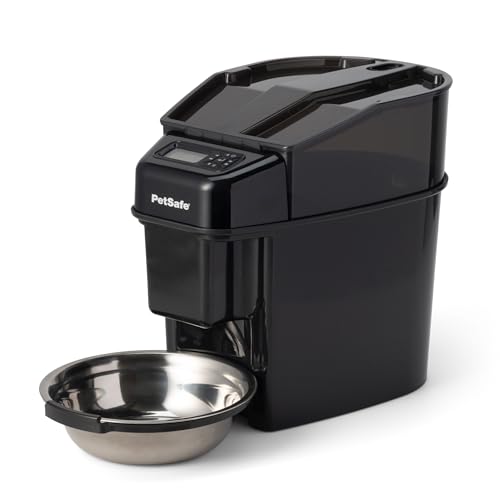
PetSafe Healthy Pet Simply Feed Automatic Feeder for Cats and Dogs, 24 Cups
When a Gravity Feeder Is the Right Choice
Gravity feeders work well for cats who self-regulate their food intake — they eat when hungry, stop when full, and maintain a healthy weight without portion control.
Choose a gravity feeder if:
- Your cat is at a healthy weight and maintains it without monitoring
- You want the simplest possible setup with no electronics, batteries, or programming
- You travel frequently and need a system that works for 3–5 day absences without a sitter
- Your cat grazes throughout the day rather than eating in distinct meals
- You have multiple cats with similar portion needs and no medical restrictions
Gravity feeder advantages:
- No power required, no batteries, no motor to fail
- No programming, no setup, no app to maintain
- Holds 1–2 weeks of food for extended absences
- Zero noise — no motor sound at all
- Lowest cost, lowest maintenance
Gravity feeder disadvantages:
- No portion control — food is always available
- Some cats overeat chronically, leading to obesity
- Some cats with anxiety use eating as a coping mechanism — constant access makes this worse
- Can go stale faster since air contacts the food continuously
- Not appropriate for cats on medical diets with strict portion requirements
When an Automatic Timed Feeder Is the Right Choice
Timed feeders solve a completely different problem: they give you control over how much and when your cat eats.
Choose a timed feeder if:
- Your cat is overweight or gaining weight on free-feeding
- Your cat eats too fast and vomits undigested food
- You have a diabetic cat whose meals must sync with insulin injections
- You want to stop your cat from waking you at 4am for food
- Your vet has prescribed a specific daily caloric intake
Timed feeder advantages:
- Precise portion control — dispense exactly 1/4 cup or 1/8 cup, consistently
- Stops night-time food demands by setting an early-morning scheduled meal
- Supports medical protocols requiring feeding at exact times
- Works for cats who guard the food bowl from other cats — scheduled meals reduce competition windows
- Supports weight loss plans with monitored daily intake
Timed feeder disadvantages:
- Requires programming and initial setup
- Needs power (and battery backup for reliability)
- Motor and mechanical parts can fail
- Not appropriate for cats who need constant food access (some medical conditions)
See timed automatic feeder rankings
Side-by-Side Comparison
| Feature | Gravity Feeder | Timed Feeder |
|---|---|---|
| Portion control | None — free access | Yes — precise per meal |
| Power required | No | Yes (+ battery backup recommended) |
| Setup time | 2 minutes | 15–30 minutes |
| Failure modes | Kibble jamming only | Motor, power, programming |
| Best for | Self-regulating cats | Overweight / medical cats |
| Vacation use | Up to 5–7 days unattended | Up to 2 weeks with battery backup |
| Price range | $15–$60 | $40–$180 |
| Noise | Silent | Quiet motor during dispense |
The Hybrid Case: Using Both
Some multi-cat households use both types simultaneously:
- Timed feeder for the cat who needs portion control
- Gravity feeder for the cat who self-regulates well
This works well when the cats eat in different locations. Combine with room separation or microchip-activated feeders to prevent the portion-controlled cat from accessing the gravity feeder.
The One Question That Decides It
Is your cat at a healthy weight and maintaining it without any intervention?
- Yes → Gravity feeder. Don’t add complexity that isn’t needed.
- No (gaining weight, eating too fast, on a medical protocol) → Timed feeder. You need portion control.
If you’re unsure about your cat’s weight, your vet can classify them on the BCS (Body Condition Score) scale from 1–9. A score of 4–5 is ideal. A score of 6 or above means portion control is warranted.
Frequently Asked Questions
Can I convert a gravity feeder into a timed feeder?
No. Gravity feeders rely on physical gravity flow — there’s no mechanism to stop food from dispensing until a set time. If you want timed access to a gravity feeder, you’d need a motorized lid cover (sold separately for some models), but this is an awkward solution. Better to buy a dedicated timed feeder.
My cat finishes their timed feeder portion immediately and then cries for more. What do I do?
This is normal for the first 1–2 weeks of switching from free-feeding to timed feeding. Your cat is adjusting. As long as the daily caloric intake is appropriate (confirm with your vet), continue the schedule. Hunger cries typically subside after 10–14 days as the cat accepts the new feeding pattern.
Is it okay to mix gravity feeding and timed feeding in the same day?
Not recommended. Mixing free access and scheduled meals undermines the behavioral pattern the timed feeder is trying to establish. Your cat will learn to eat maximally during the free-access window and ignore the timed dispenses.
I need a feeder that works when the power is out but also gives portion control. Which type?
A timed feeder with battery backup. Battery backup feeders continue their schedule during outages. Gravity feeders don’t provide portion control regardless of power status.
For detailed rankings of either type: Gravity Feeder Rankings or Timed Auto Feeder Rankings. If you need both types in a multi-cat home, see Multi-Pet Feeder Rankings.
This post contains affiliate links. We may earn a commission when you purchase through our links at no extra cost to you.