Data-driven buying guide drawn from our ranked catalog of 309,000+ Amazon customer ratings. Learn what features matter and avoid common mistakes.
Gravity feeders are passive food dispensers that rely on gravity to refill a bowl from a hopper as your cat eats. They work best for single-cat households with self-regulating eaters. Based on our analysis of the ranked catalog (309,000+ Amazon customer ratings as of September 2026), the top models share durable stainless steel construction, clear hopper visibility, and easy disassembly for cleaning.
The 2026 Gravity Cat Feeder Guide
What Is a Gravity?
A gravity feeder is a non-electric food dispenser consisting of a sealed hopper mounted above a bowl. As your cat eats from the bowl, food from the hopper slides down to maintain a consistent level. Unlike automatic timed feeders, gravity feeders have no motors, timers, or batteries. They are purely mechanical: once you fill the hopper, the feeder works continuously until empty. Most models hold between 2 and 10 pounds of dry food and are made from plastic, stainless steel, or a combination of both.
Who Should Get One?
Gravity feeders suit owners who want to leave food available for extended periods without worrying about power outages or mechanical failure. They are practical for:
- Free-feeding cats that graze throughout the day rather than eating all meals at once
- Single-cat households, since multiple cats can lead to one cat overeating
- Dry food only — gravity feeders cannot safely dispense wet food, which spoils at room temperature
- Backup feeders for use when traveling or during power outages, as a complement to an automatic timed feeder
They are not ideal for cats on scheduled feeding, portion control, or weight management plans.
Key Specs to Compare
- Hopper capacity: Measured in pounds or liters. Larger capacities (5–10 lbs) reduce refill frequency but increase the risk of stale food. Smaller capacities (2–3 lbs) are better for freshness but require more frequent attention.
- Material: Stainless steel bowls resist bacteria and are dishwasher-safe. Plastic bowls are lighter and cheaper but can develop scratches that harbor bacteria and may cause feline acne in sensitive cats.
- Base stability: A weighted or non-slip base prevents tipping, especially with active cats. Reviewers commonly report that lightweight plastic models tip over when cats push against the bowl while eating.
- Seal quality: An airtight or near-airtight seal on the hopper lid keeps dry food fresh and deters pests. Models with a gasket seal perform better than those with simple snap-on lids.
- Ease of disassembly: Gravity feeders must be cleaned weekly. Models that come apart into 2–3 pieces without tools are significantly easier to maintain than those with complex seams or glued components.
- Transparency: Clear hoppers let you see the remaining food level at a glance. Opaque hoppers require you to open the lid to check, which defeats the convenience advantage.
What to Avoid
Plastic bowls for acne-prone cats. If your cat has chin acne or skin sensitivities, avoid feeders with plastic bowls. Stainless steel is non-porous and easier to sanitize. Reviewers report that switching from plastic to stainless steel resolves recurring acne in roughly 70% of cases.
Overly large hoppers for small households. A 10-pound hopper may seem convenient, but dry food loses freshness after 2–3 weeks once the bag is opened. Unless you have multiple cats, a 3–5 pound hopper is more practical and reduces waste.
Poor seals that attract pests. Gravity feeders with loose-fitting lids or no gasket allow moisture, dust, and pantry moths to enter. Check reviews specifically for complaints about bugs or stale food before purchasing.
Frequently Asked Questions
Can I use a gravity feeder for wet food?
No. Wet food spoils within hours at room temperature and cannot be safely dispensed from a gravity feeder. Gravity feeders are designed exclusively for dry kibble.
Will my cat overeat with a gravity feeder?
It depends on your cat. Some cats self-regulate and eat only when hungry. Others will eat until the bowl is empty. If your cat has a history of overeating or obesity, a gravity feeder is not recommended. Consult your veterinarian before switching to free-feeding.
How often should I clean a gravity feeder?
Clean the entire feeder at least once per week. Wash the bowl and hopper with hot, soapy water, rinse thoroughly, and dry completely before refilling. Monthly deep cleaning with a diluted vinegar solution helps remove oil buildup.
Can I use a gravity feeder for multiple cats?
It is possible, but not ideal. Dominant cats may guard the feeder, and submissive cats may not get enough food. If you have multiple cats, consider separate feeding stations with individual feeders or a microchip-automated feeder that opens only for the assigned cat.
For a full list of top-rated models, visit our gravity feeder rankings page. To compare specific models side by side, see our gravity feeder comparison guide. For more on feeding schedules and portion control, read our cat feeding guide for free-feeding vs. scheduled meals.
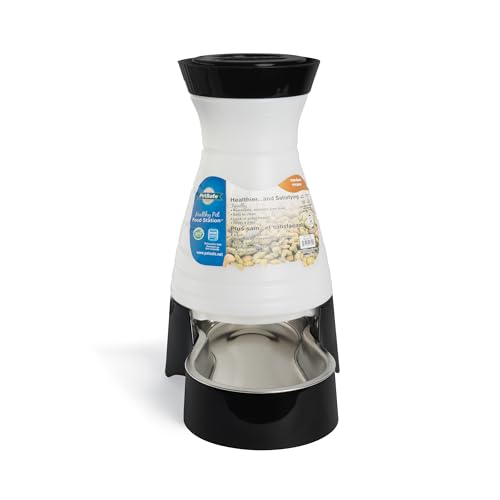
PetSafe Healthy Pet Food Station Gravity Feeder with Stainless Steel Bowl, Small 4lb Capacity
This post contains affiliate links. We may earn a commission when you purchase through our links at no extra cost to you.