Is a cat water fountain actually better for your cat's health than a standard bowl? We break down the veterinary science on hydration, kidney disease, and why flowing water changes feline behavior.
The Evolutionary Problem with the Water Bowl
To understand why cats often ignore perfectly clean water in a standard bowl, you have to look at their evolutionary history. The domestic cat (Felis catus) evolved from the African wildcat (Felis lybica), a desert-dwelling predator.
In the wild, these ancestors got 70-80% of their daily moisture requirement directly from the prey they consumed. They rarely needed to seek out standing water. When they did, their instincts told them two things:
- Running water is generally safe and fresh.
- Standing, stagnant water is a breeding ground for bacteria and parasites.
When you place a standard bowl of still water on the floor, your cat’s evolutionary instinct sees a puddle of stagnant, potentially unsafe water. This is why many cats prefer to drink from a dripping sink faucet rather than a fresh bowl—the movement signals safety.
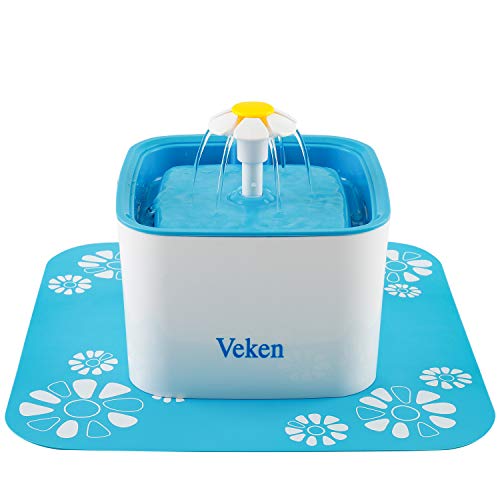
Veken Pet Fountain 84oz/2.5L Automatic Cat Water Fountain with 3 Replacement Filters & 1 Silicone Mat
Health Benefit 1: Increased Total Hydration
The primary medical benefit of a water fountain over a bowl is simply that it encourages the cat to drink more water.
Why this matters: Modern indoor cats are often fed a diet primarily consisting of dry kibble, which contains only 5-10% moisture. Because cats have a naturally low thirst drive (expecting to get moisture from food), a dry diet leaves them in a state of chronic, mild dehydration.
A study in the Journal of Feline Medicine and Surgery showed that cats offered moving water sources consumed measurably more water per day than cats offered only still bowls.
Increased hydration is the single most effective preventative measure against Feline Lower Urinary Tract Disease (FLUTD), which includes life-threatening urethral blockages in male cats. More water means more dilute urine, which prevents the formation of struvite and calcium oxalate crystals.
Health Benefit 2: Chronic Kidney Disease (CKD) Management
Chronic Kidney Disease affects roughly 30% of cats over age 10. As the kidneys lose function, they lose the ability to concentrate urine. The cat urinates more volume and consequently needs to drink significantly more water to replace it.
For a senior cat with CKD, maximizing water intake is the cornerstone of disease management.
A standard bowl often fails here. Senior cats can be forgetful or have reduced vision. The sound of a water fountain acts as an auditory cue, reminding the cat where the water is and prompting them to drink when they walk by. Furthermore, the circulating nature of a fountain keeps the water cooler and more oxygenated, which many cats find more palatable.
Health Benefit 3: Whisker Fatigue Prevention
A cat’s whiskers are incredibly sensitive tactile sensors. Every time a whisker brushes against a surface, it sends a neurological signal to the brain.
When a cat drinks from a standard, deep water bowl, their whiskers are constantly pressed against the sides. Over time, this constant sensory stimulation causes a condition colloquially known as “whisker fatigue”—a sort of sensory overload that causes the cat pain or extreme annoyance.
This is why some cats will dip their paw into a bowl and lick the water off, rather than putting their face in.
While you can buy wide, shallow drinking bowls to prevent this, a high-quality fountain usually features a large, flat drinking surface or a bubbling top that allows the cat to drink without their whiskers ever touching a rim.
Health Benefit 4: Water Quality and Filtration
A standard water bowl is a catch-all for dust, cat hair, and saliva. Within hours, a biofilm (a slimy layer of bacteria) begins to form on the bottom and sides of the bowl.
Water fountains utilize continuous mechanical and chemical filtration:
- Mechanical filters (sponge/mesh): Catch floating hair, dust, and food particles before the cat drinks them.
- Chemical filters (activated carbon): Adsorb chlorine, heavy metals, and the organic compounds that cause water to taste “stale.”
This filtration doesn’t just make the water safer; it makes it taste better. Cats have highly sensitive taste receptors for water (unlike humans), and the removal of municipal chlorine and chloramines via a carbon filter often dramatically increases their willingness to drink.
Are There Any Downsides to a Fountain?
While fountains win on health benefits, they lose on maintenance convenience.
A bowl takes 10 seconds to wash and refill. A fountain requires complete disassembly every 1-2 weeks for cleaning, pump maintenance, and filter replacement. If a fountain is not cleaned regularly, the internal pump mechanism becomes a breeding ground for bacteria, completely negating the health benefits.
The Verdict
If you feed your cat a 100% wet food diet, they are likely getting sufficient moisture from their food, and a daily-washed stainless steel or ceramic bowl is perfectly adequate.
However, if your cat eats primarily dry kibble, has a history of urinary crystals, or is a senior cat, a water fountain is a medically sound investment that actively protects their kidney and urinary health.
Ready to make the switch? See our rankings for the Best Filtered Water Fountains or, for maximum hygiene, the Best Stainless Steel Fountains.
This post contains affiliate links. We may earn a commission when you purchase through our links at no extra cost to you.