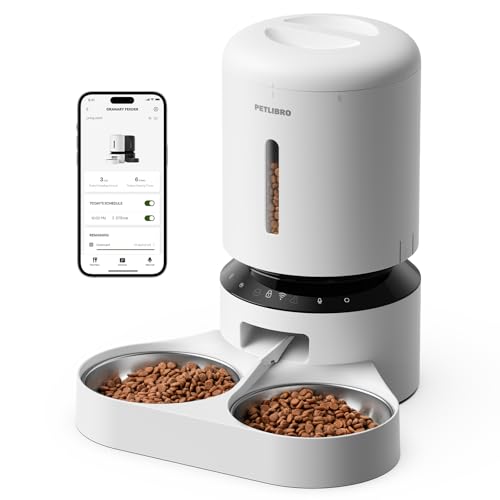
Going on vacation for 2 weeks? We analyzed what happens when automatic feeders are left unattended for 14 days — and which models have the reliability, capacity, and backup power to get your cat through it safely.

The Hard Truth About 2-Week Solo Vacations
Leaving a cat alone for 14 days is the edge case that exposes every flaw in an automatic feeder. A model that works flawlessly for 2 days under observation can fail silently on day 9 when you’re 3 time zones away.
The most common failure modes during extended absences:
- Kibble bridging: Dry food compacts and forms an arch inside the hopper, stopping dispensing. The feeder “thinks” it dispensed; your cat gets nothing.
- Power outage with no backup: Even a 2-hour outage resets some feeders’ schedules to factory default.
- Motor jam from humidity: Summer humidity swells kibble slightly, causing it to stick in the auger mechanism.
- Wi-Fi feeder losing connection: App feeders revert to local schedule or stop dispensing when disconnected from the cloud — behavior varies by brand.
This guide focuses on what actually prevents these failures over 14 days.
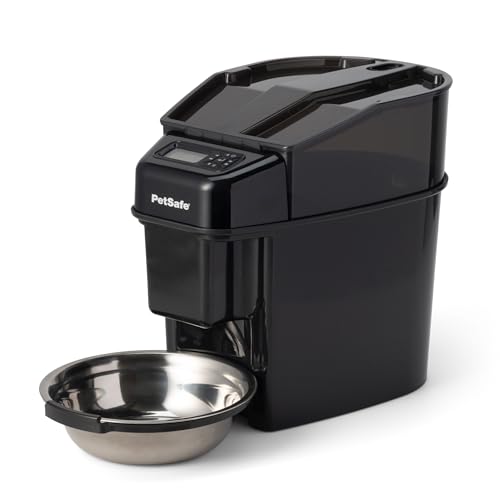
PetSafe Healthy Pet Simply Feed Automatic Feeder for Cats and Dogs, 24 Cups
The Non-Negotiables for a 2-Week Absence
1. Battery Backup (Not Optional)
Any feeder without battery backup is disqualified for a 2-week unsupervised absence. Power blips happen. A feeder running purely on DC power that loses power at meal #4 of 84 means 80 meals never happen.
Look for: dual power (DC adapter + AA or D-cell batteries), or a built-in rechargeable battery with at least 72-hour reserve.
2. Sufficient Hopper Capacity
Standard calculation: a typical adult cat needs roughly 1/3 to 1/2 cup of dry kibble per day. For 14 days: 4.5 to 7 cups minimum hopper capacity.
Most mid-range feeders hold 4–6 liters (~17–25 cups). This is more than enough. Budget feeders under 1.5 liters will run out by day 5 for most cats.
3. Anti-Jam Dispensing Design
The auger-type dispenser (a rotating screw mechanism) is more jam-resistant than a wheel dispenser for most kibble sizes. However, large round kibble (over 1cm diameter) can still bridge.
Practical fix: Use smaller-than-usual kibble during the vacation period. Most brands make the same formula in multiple sizes — the smaller variety flows more freely.
4. Someone Checks In (At Least Once)
No feeder is fail-safe. For a 14-day absence, arrange for a neighbor, friend, or pet sitter to visually confirm the feeder is running on day 3 or 4. This single check catches any early failure before it becomes a welfare issue.
If that’s not possible, an app feeder with camera lets you verify remotely. You can trigger a manual dispense, check the bowl, and confirm your cat is eating — all from your phone.
The Two Feeder Types Worth Considering
Option A: High-Capacity Timed Feeder with Battery Backup (Best Reliability)
For cat owners who want zero dependency on Wi-Fi or apps, a pure timed feeder with a large hopper and battery backup is the most robust choice.
These are mechanical in their core — no cloud, no app, no connectivity failure possible. The schedule you set at 6am will run at 6am on day 14 without any network.
What to confirm before purchase:
- Battery backup specifically mentioned (not just “battery operated” — you want a feeder that runs on DC and falls back to battery)
- Hopper capacity of 4+ liters
- Anti-jam auger or rotating drum dispenser
See current top-ranked timed feeders
Option B: App-Controlled Feeder with Camera (Best Visibility)
For cat owners who need peace of mind during a long trip, an app feeder with a camera is worth the extra complexity.
The key benefit: You can see your cat eating. For anxious owners, this matters enormously. You can also manually dispense a bonus meal from the airport if you get delayed.
The key risk: Wi-Fi drops, cloud servers can have outages, and some brands have discontinued app support. Choose brands with a clear offline fallback schedule mode — so if connectivity fails, scheduled meals still happen locally.
See app-controlled feeder rankings
Water for a 2-Week Absence
A feeder handles food; water is a separate critical system. For 14 days:
- A standard fountain with a 2–3 liter capacity will run dry in 3–5 days. This is not sufficient for 14 days unattended.
- You need either: (1) a very large-capacity fountain (5+ liters), or (2) a fountain connected to a water line via a drip adapter, or (3) a pet sitter refilling water.
- Gravity water dispensers (large jugs that slowly release into a bowl) can work for 7–10 days but go stale — the water develops an off-taste that cats may refuse.
The combination most owners in our review analysis use for 2-week absences: large timed feeder + pet sitter checking water every 4–5 days.
Checklist Before You Leave
- Run the feeder for 3 full days before departure — confirm every scheduled meal dispensed correctly
- Fill hopper the morning of departure, not the night before (reduces humidity exposure in storage)
- Set one extra meal per day as insurance (cats under stress during owner absence sometimes eat less)
- Confirm battery backup batteries are fresh (not leftover from 2 years ago)
- If using app feeder: verify offline schedule is saved locally on the device
- Provide emergency contact with your vet’s number and feeder model/instructions
Frequently Asked Questions
Is it okay to leave a cat alone for 2 weeks with an automatic feeder?
Veterinarians generally recommend a maximum of 24–48 hours completely alone. For a 2-week absence, a daily or every-other-day check-in (by a friend, neighbor, or pet sitter) is considered standard of care. The feeder handles meals; human oversight handles emergencies.
What if the kibble runs out before I return?
Set your feeder to dispense slightly less per day than your cat’s full ration — this creates a buffer. Cats tolerate 10–15% caloric restriction without health issues. An extra day of food in the hopper is more valuable than maximizing daily portion.
Should I leave a bowl of dry food as backup?
No. A large open bowl of food encourages binge eating, defeats portion control, and can go stale or attract insects over 14 days. Trust the feeder, verify once via someone else, and use the feeder’s built-in capacity.
My feeder says it holds “15 cups.” Is that enough?
For an average adult cat (1/3 cup per day × 14 days = 4.7 cups), yes. The 15-cup capacity gives you 3x buffer. The limiting factor for most cat owners is the hopper width causing kibble to bridge — not running out of food.
For full rankings with capacity and backup power specifications: Timed Auto Feeders or if you want remote monitoring, App-Controlled Feeders.
This post contains affiliate links. We may earn a commission when you purchase through our links at no extra cost to you.