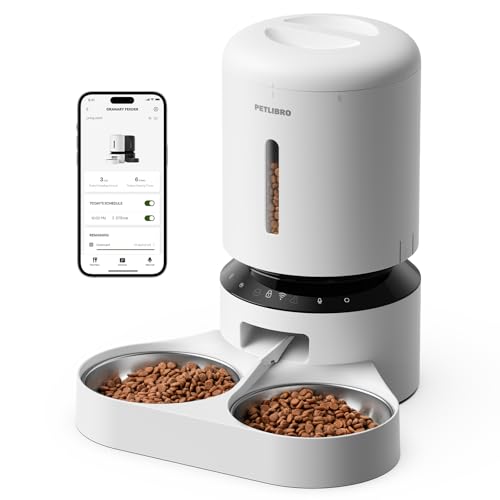
Data-driven buying guide drawn from our ranked catalog of 309,000+ Amazon customer ratings. Learn what features matter and avoid common mistakes.
Automatic Timed Feeder are programmable devices that dispense pre-measured portions of dry food at set times, operating on a timer rather than a sensor or app. They work best for cats on a strict feeding schedule when you are away for predictable hours, or for owners who want portion control without smart features. Based on our analysis of the ranked catalog (309,000+ Amazon customer ratings as of September 2026), the top models share reliable mechanical timers, easy-to-clean food hoppers, and consistent portion sizes.
The Complete Automatic Timed Cat Feeder Guide (2026)
What Is a Automatic Timed Feeder?
An automatic timed feeder is the simplest type of programmable pet feeder. Unlike Wi-Fi models that require an app, or gravity feeders that rely on refilling a bowl, timed feeders use a built-in clock or mechanical timer to release food at preset intervals. Most operate on batteries or AC power, with a backup battery to retain settings during outages.
The core function is straightforward: you set the time(s) for meals, load the hopper with dry kibble, and the feeder rotates a dispensing mechanism (usually an auger or rotating drum) at the programmed moment. Portion sizes are adjustable in increments, typically from 1/8 cup to 1 cup per meal. Many models can hold 3–6 pounds of dry food and dispense up to 4–6 meals per day.
These feeders are distinct from smart feeders because they lack remote control, feeding history, or camera features. They are also different from gravity feeders because they do not allow unlimited access—the cat eats only when the feeder opens.
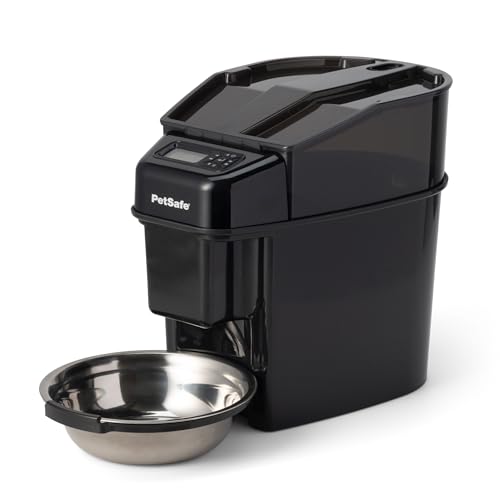
PetSafe Healthy Pet Simply Feed Automatic Feeder for Cats and Dogs, 24 Cups
Who Should Get One?
An automatic timed feeder is a practical choice if:
- You have a predictable schedule — You leave for work at the same time each day and return at a consistent hour.
- Your cat needs portion control — You want to measure exact amounts per meal without relying on a sensor or app.
- You prefer simplicity — You do not want to manage a smartphone app, Wi-Fi connection, or firmware updates.
- You travel occasionally — A timed feeder can handle a weekend away if you have someone to check water and the feeder’s battery.
- Your cat is not a chewer or batterer — Timed feeders are typically plastic and can be knocked over by determined cats.
It is not ideal if your cat eats wet food (most timed feeders only handle dry kibble), if your cat needs multiple small meals throughout the day (timed feeders have limited meal slots), or if you want to monitor feeding remotely.
Key Specs to Compare
When choosing an automatic timed feeder, focus on these measurable features:
- Meal capacity & hopper size — Look for a hopper that holds at least 3 pounds of dry food to avoid frequent refills. Larger hoppers (5–6 pounds) suit multi-cat households or longer absences.
- Portion control range — The smallest increment matters. Some feeders dispense as little as 1/8 cup; others start at 1/4 cup. For small cats or precise diets, smaller increments are better.
- Number of meals per day — Most models support 2–4 meals. If your cat needs 5–6 small meals, you may need a feeder with more programming slots or a different type.
- Battery type and backup — Mechanical timers often use D-cell or C-cell batteries. Digital timers use AA or AAA. Look for models that retain time and settings when unplugged (many lose programming if batteries die).
- Dispensing mechanism material — Stainless steel or ceramic dispensing parts resist bacteria better than plastic. Plastic augers can wear down over time and may harbor odors.
- Ease of cleaning — The food hopper and dispensing chute should be removable and dishwasher-safe (top rack). Avoid models with non-removable parts that trap kibble dust.
What to Avoid
-
Overly complex programming — Some timed feeders have confusing button sequences or tiny LCD screens that are hard to read. Reviewers commonly report frustration with setting the clock on no-name brands. Stick to models with clear, labeled buttons or digital displays that are intuitive.
-
Flimsy construction — Cheap plastic feeders can crack at the hinge or hopper seal within months. Look for reinforced lids and a locking mechanism that prevents the cat from prying it open. If the lid does not seal tightly, moisture can get in and spoil the kibble.
-
Missing backup battery — If the feeder requires AC power and loses its programming when unplugged, a power outage could cause missed meals. Always choose a model that uses batteries as the primary or backup power source, and test it before relying on it for a trip.
Frequently Asked Questions
Can I use an automatic timed feeder for wet food?
No. Automatic timed feeders are designed for dry kibble only. Wet food will spoil within hours at room temperature and can clog the dispensing mechanism. If you need to feed wet food, look for a refrigerated feeder or a model with an ice pack compartment, but those are rare and generally unreliable.
How long will a timed feeder run on batteries alone?
It depends on the model and battery type. Most digital timed feeders with AA batteries last 4–6 weeks with normal use. Mechanical timers with D-cell batteries can last 3–6 months. Check the product specifications for “battery life” or “low battery indicator” — a low battery warning is essential to avoid missed meals.
Will my cat break into the feeder?
Some cats can. Reviewers commonly report that determined cats can pry open lids that do not lock securely. Look for a lid that snaps shut with a firm click or uses a locking tab. For extra security, place the feeder in a corner or against a wall so the cat cannot tip it over. Avoid feeders with exposed seams that paws can grip.
How do I clean a timed feeder?
Unplug the feeder and remove all kibble. Most models have a removable hopper and dispensing chute that can be washed in warm, soapy water or the top rack of a dishwasher. Wipe down the base with a damp cloth, avoiding the motor and battery compartment. Dry all parts completely before reassembling. Clean the feeder every two weeks to prevent kibble dust buildup and odor.
Related Resources
This post contains affiliate links. We may earn a commission when you purchase through our links at no extra cost to you.