Feeding two cats different diets automatically requires true physical access control—not just a dual-bowl splitter. Here is the verified hardware setup that completely prevents food theft and cross-contamination.
Feeding two cats who thrive on the exact same kibble is simple. But the moment one cat requires prescription kidney food, a weight-loss formula, or special allergy kibble, multi-cat feeding becomes a high-stakes daily battle.
The most common and costly mistake cat owners make is purchasing a generic “dual-bowl automatic feeder” thinking it will solve their problem. It will not. A dual-bowl feeder shares a single food hopper—it cannot dispense two different foods. Worse, it offers zero access control; a dominant cat will simply scarf their share and push the second cat out of the way to eat the rest.
If you need to feed two cats different diets automatically without supervising every meal, here is the exact hardware matrix and behavioral layout that prevents mealtime theft and cross-contamination.
10-Second Hardware Matcher: Finding Your Multi-Cat Setup
Compare high-capacity slow feeders against dual-bowl splitters and rotary wet dispensers to determine which hardware configuration solves your multi-cat mealtime conflict.
Two Cats, Different Diets: 10-Second Hardware Matcher
Direct side-by-side evaluation across anti-theft defense, slow-feed pacing, and multi-feline portion safety.
| Key Feature | Best for Fast Eaters & Large Capacity 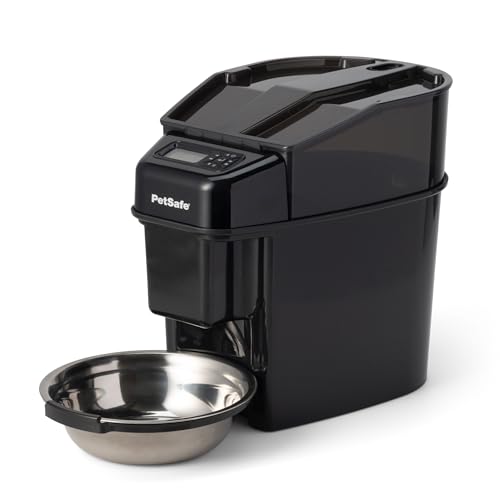 PetSafe Healthy Pet Simply Feed Automatic Feeder for Cats and Dogs, 24 Cups $70+ | Best for Two Friendly Cats 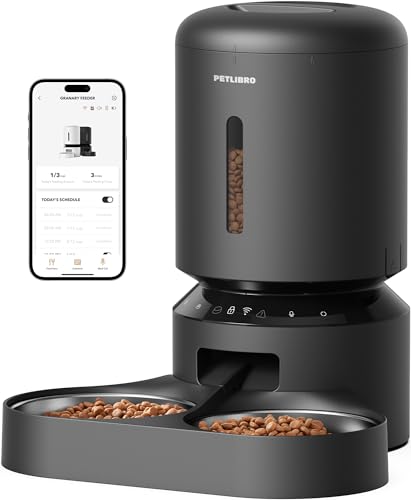 PETLIBRO Automatic Cat Feeder for 2 Cats, 5L Granary Dual Bowl Auto Cat Food Dispenser $70+ | Best Value Multi-Cat Timed Feeder 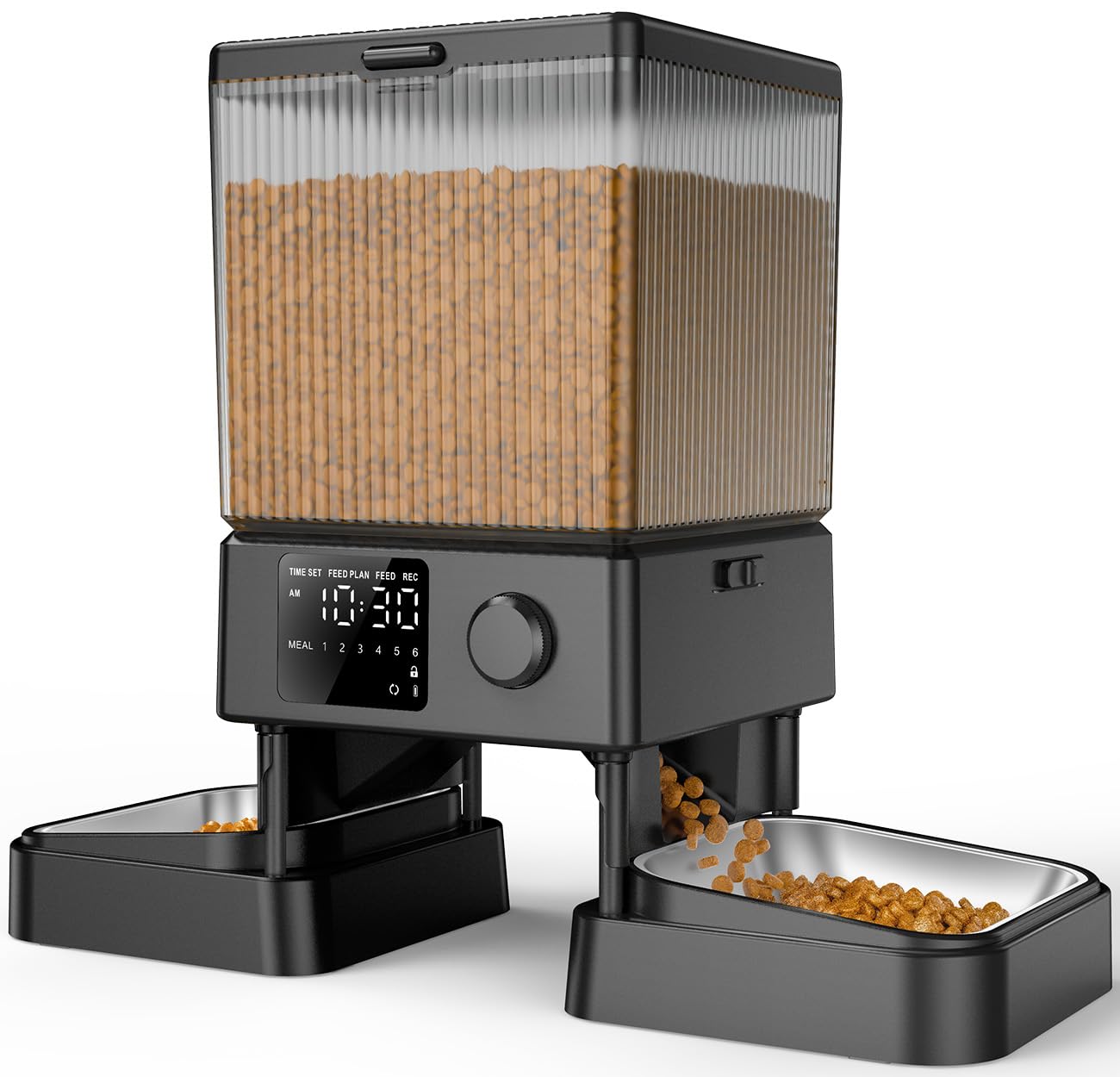 oneisall Automatic Cat Feeder for 2 Cats Pets, Timed Cat Food Dispenser 20 Cups/5L with Dual Stainless Bowls $30–$70 | Best for Wet Canned Food & Medication 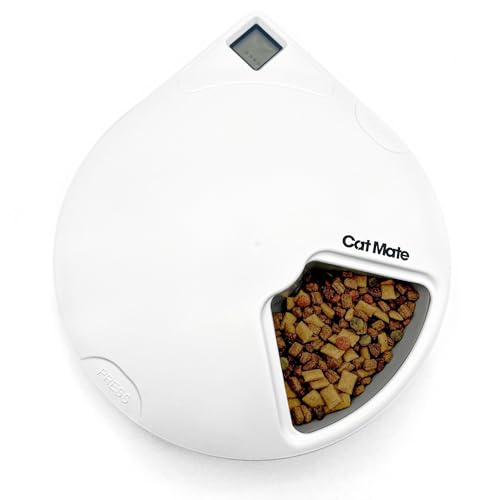 Cat Mate C500 Digital 5 Meal Automatic Pet Feeder with Ice Packs for Wet & Dry Food, Twin Ice Packs Keep Canned Wet Food Fresh for Cats $30–$70 |
|---|---|---|---|---|
| lock Anti-Theft & Jam | verified_user Tamper-Proof Motorized Conveyor Dispensing Mechanism (Pet-proof & Anti-jam) | verified_user Tamper-Proof Patented 2-Way Meal Splitter with Auto-Reversing Rotor | shield Reinforced Dual-wing two-way splitter with anti-clog reverse rotation | verified_user Tamper-Proof Rotary 5-Compartment Carousel (Zero Jam Risk) |
| health_and_safety Feline Chin Acne | check_circle 304 Safe Steel 304 Food-grade Stainless Steel | check_circle 304 Safe Steel Dual 304 Food-grade Stainless Steel Bowls | check_circle 304 Safe Steel Dual 304 Food-grade Stainless Steel Bowls | warning Plastic Bowl BPA-Free Food Grade Plastic with Twin Ice Packs |
| battery_charging_full Outage Defense | 4x D-cell Alkaline Batteries (Optional 9V AC adapter) | 3x D-cell Alkaline Batteries (up to 180 days) | 4x AA Batteries (Backup during power cuts) | 3x AA Batteries (Runs for ~12 months on a single set) |
| gavel Our Quick Verdict | "24-cup conveyor feeder with 15-minute Slow Feed mode and up to 12 scheduled meals" | "Dual 304 steel bowls with a balanced central splitter and twist-lock lid" | "5L hopper with dual elevated stainless steel bowls and easy onboard programming" | "Rotating 5-compartment carousel with twin ice packs to preserve freshness" |
| Check Live Deals |
The Core Problem: Why Conventional Feeders Fail Two-Cat Homes
To choose the right hardware, you must assess the medical stakes of your cats’ differing diets:
- High Medical Stakes (Prescription & Therapeutic Diets): If one cat is on a renal, urinary (SO), hepatic, or hypoallergenic formula, the other cat eating it can cause serious metabolic harm. Conversely, if your sick cat eats regular adult kibble, their medical condition can deteriorate quickly. In this scenario, physical access control is non-negotiable.
- Medium Stakes (Weight Management vs. Free-Grazing): One cat eats rapidly like a vacuum cleaner, while the other is a timid grazer who prefers eating two kibbles every 30 minutes. A shared feeder results in one obese cat and one malnourished, anxious cat.
- Low Stakes (Portion Disparity of the Same Kibble): Both cats eat identical standard dry food, but Cat A needs 40g daily and Cat B needs 60g daily. Here, an adjustable split-hopper or staggered timed feeder can suffice.
The Winning Hardware: Tested Multi-Cat Solutions
Here is our detailed teardown of the four proven hardware options for multi-cat households facing dietary divergence.
1. Best for Anti-Gorging & Staggered Feeding: PetSafe Healthy Pet Simply Feed
When feeding two cats with different appetite paces or portion requirements, the PetSafe Healthy Pet Simply Feed eliminates the “scarf and steal” cycle using high-precision timed micro-portions and an exclusive Slow Feed mode.
How It Solves the Separation Problem
In two-cat homes where one cat bolts food in two minutes and immediately bullies the slower grazer away from their dish, timing is everything. The PetSafe Simply Feed holds an enormous 24 cups (5.6L) and schedules up to 12 meals a day in fine-tuned portions starting at 1/8 cup.
Its standout weapon is the proprietary Slow Feed mode: for any portion above 1/8 cup, the internal motorized conveyor dispenses the meal gradually over a 15-minute window rather than dumping it all at once. This keeps the fast eater occupied at their own station for 15 full minutes, giving the slower cat ample time to finish undisturbed. Furthermore, the patented conveyor belt mechanism creates a physical barrier that completely prevents clever paws from reaching up the chute to shake loose extra kibble.
The Honest Trade-offs
Because it dispenses into a single included 304 stainless steel bowl, this is not an RFID microchip door—it will not physically lock out an unauthorized cat if placed side-by-side with another feeder in an open room. To feed two cats on different prescription diets, you must place two separate units in different rooms (or across a barrier) and leverage staggered schedules. Additionally, the conveyor belt assembly must be washed by hand, and 4 D-cell batteries are not included.
2. Best for Harmonious Pairs on the Same Food: PETLIBRO Granary Dual Bowl
If your cats do not have medical diet conflicts and simply need equal, stress-free portioning of standard kibble, the PETLIBRO Granary Dual Bowl Feeder eliminates feeding anxiety without the cost of two microchip units.
How It Solves the Separation Problem
Instead of relying on luck, the Granary utilizes an internal two-way mechanical meal splitter engineered to distribute kibble at a balanced 50:50 ratio with under 3% measured variance. The two wide, shallow 304 stainless steel bowls sit comfortably separated, minimizing whisker fatigue and preventing mealtime shoulder collisions.
The Honest Trade-offs
Do not buy this model if your cats eat different foods. Both bowls receive kibble from the same centralized 5L tank. If one cat is an aggressive food thief who bullies the other cat away from both bowls, this feeder cannot physically lock the bully out.
3. Best High-Capacity Value Splitter: oneisall 5L Dual Stainless Bowl Feeder
For multi-cat owners on a tighter budget who need massive storage capacity and straightforward offline reliability, the oneisall Dual Bowl Feeder provides robust basic utility.
How It Solves the Separation Problem
Holding a massive 20 cups (5 liters) of kibble, this unit features dual elevated stainless steel bowls that reduce neck strain for senior cats. The timed dispensing mechanism operates without requiring an active Wi-Fi connection, making it completely impervious to network drops or router reboot loops.
The Honest Trade-offs
The meal splitter is fixed and slightly less balanced than the PETLIBRO Granary when dispensing triangular or non-spherical kibble. Cleaning the integrated base assembly also requires disassembling more individual plastic screws.
4. Best for Wet Food & Scheduled Medication: Cat Mate C500 Digital 5-Meal
If your dietary difference involves wet canned food, prescription broths, or timed medications that dry kibble dispensers cannot handle, the Cat Mate C500 is the essential specialized choice.
How It Solves the Separation Problem
Equipped with dual frozen gel ice packs nestled below five food compartments, the Cat Mate C500 keeps wet food fresh and hygienic for up to 24 hours. If Cat A requires thyroid pills crushed into wet pate at 7:00 AM while Cat B eats dry food, programming this carousel ensures the medicated meal is served on schedule.
The Honest Trade-offs
This unit does not have microchip sensing. If both cats are loose in the same room, you must place the Cat Mate C500 in a dedicated room and close the door during the 15-minute feeding window to ensure the right cat consumes the medicated meal.
Tactical Setup: 3 Behavioral Hacks to Stop Food Theft
Even superior hardware can be undermined by poor room geometry. Implement these physical layout tactics to eliminate feeding conflicts.
1. The “Blind Spot” Diagonal Placement
Never position two feeders side-by-side against the same wall or crammed into a kitchen corner. Eating is an instinctively vulnerable act for a cat. When forced into a dead-end corner, anxious cats will constantly bolt mid-meal.
- The Fix: Place the two feeders at least 8 to 12 feet apart, ideally on opposite sides of a kitchen island or in different corners where line-of-sight is broken. When neither cat can see the other eating, arousal and competitive gorging drop dramatically.
2. The Microchip “Cardboard Tunnel” Hack
If you have an assertive bully cat who tries to nudge their head into a microchip feeder alongside the timid cat, build a feeding tunnel:
- Take a standard narrow cardboard packing box open at both ends.
- Place the microchip feeder at the far inner back of the box.
- Now, only one cat can physically fit their body through the opening. The dominant cat cannot sneak up from behind or flank the authorized cat while the lid is open.
3. The 3-Stage Desensitization Protocol
Some cats are initially startled by the motor hum of opening feeder lids. To prevent fear responses:
- Days 1 to 3: Leave the feeder in “Training Mode” with the lid locked wide open. Place their favorite high-value treats inside the bowl.
- Days 4 to 7: Activate the second training tier, where the lid sits half-closed and moves slightly when the cat enters.
- Day 8+: Engage normal operational mode once your cat confidently associates the unit with food reward.
Frequently Asked Questions
Will my cat’s microchip work with selective feeders?
SureFeed microchip feeders are compatible with standard 15-digit ISO 11784/11785 veterinary chips (standard across the US, UK, Europe, and Canada since the 2000s) as well as 10-digit and 9-digit chips. If your cat is not chipped, the feeder includes an ultra-lightweight RFID collar tag that performs the exact same function.
Can a persistent cat break into the food hopper from the top?
On well-engineered models like the PetSafe Simply Feed, PETLIBRO Granary, and oneisall Dual Bowl, the top lids feature recessed, squeeze-to-open, or twist-lock mechanical latches that cannot be pried loose by cat claws or head-butting. Avoid cheap snap-on lids that pop open when knocked sideways.
What if the power goes out while I am away?
Both the PETLIBRO Granary (powered by 3 D-cell backup batteries), the oneisall Dual Feeder (powered by 4 AA backup batteries), and the PetSafe Simply Feed (4 D-cell batteries) continue operating seamlessly during electrical blackouts without losing their programmed schedules.
Can two bonded cats share one microchip feeder?
Yes. You can program up to 32 different cat microchips into a single SureFeed feeder. If you have two cats on identical senior food and a third cat on kitten food, the two senior cats can share access to one feeder while the kitten is locked out.
Need an in-depth review of single-cat dispensers? Read our Best Automatic Cat Feeder 2026 Guide or explore the complete Multi-Pet Feeder Rankings.
This post contains affiliate links. We may earn a commission when you purchase through our links at no extra cost to you.