Cats that eat too fast risk vomiting, bloat, and obesity. We analyzed 9,200+ reviews to find which automatic feeders genuinely slow down fast eaters — and which ones just rearrange kibble.
The Problem with Fast Eaters
A cat that inhales food in under 60 seconds is doing two harmful things simultaneously: ingesting air that causes vomiting, and bypassing the hormonal signal that tells the brain “I’m full.” Chronic fast eating leads to regurgitation (that cylinder of undigested kibble you find on the carpet), and over months, contributes to obesity.
The fix isn’t willpower — cats don’t have it. The fix is mechanics: make the food physically harder to reach in one swipe.
Automatic feeders solve this through three mechanisms: portion size control, meal frequency, and in some models, physical barrier dispensing that forces slower eating by design.
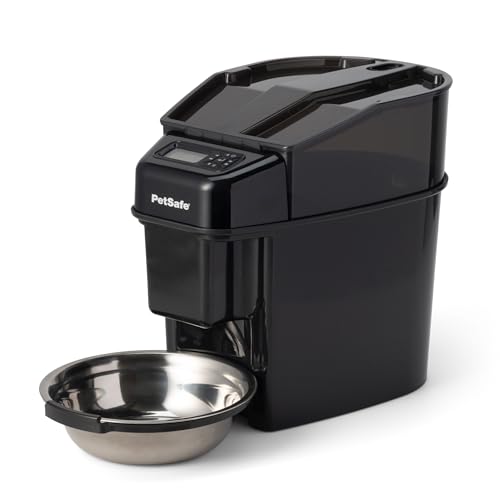
PetSafe Healthy Pet Simply Feed Automatic Feeder for Cats and Dogs, 24 Cups
What You Actually Need: Portion + Frequency Control
A gravity feeder — where food flows freely into the bowl — will not help a fast eater. It makes the problem worse by ensuring an always-full bowl.
What works:
Small, frequent meals: Instead of 2 large meals, schedule 4–6 small portions per day. An automatic timed feeder can dispense at 6am, 9am, 12pm, 3pm, 6pm, 9pm — a size that takes 2 minutes to eat, not 20 seconds. The cat’s hunger is managed, binge-eating impulse is reduced.
Restricted single-serving bowls: The dispensed meal lands in a bowl sized for that portion only. No excess visible food = no opportunity to wolf more.
Slow-feeder disc inserts: Some automatic feeders come with a maze-pattern insert that sits inside the bowl. The cat must navigate the maze to reach kibble. Eating time extends from 15 seconds to 3–5 minutes for the same amount of food.
The Best Feeder Types for Fast Eaters
Timed Portion-Control Feeders (Best Overall)
These feeders dispense a fixed amount on a fixed schedule. They’re the most reliable solution because portion size and timing are entirely under your control.
Key specs to look for:
- Minimum portion size: You want a feeder that can dispense as little as 1/24 cup (about 3–4 grams) per meal. Many budget models only go down to 1/12 cup, which is too large for micro-meal scheduling.
- Meal count: A feeder supporting up to 6 or more meals per day gives you the most flexibility.
- Battery backup: If your cat eats 6 times per day and the power cuts out, they miss meals. Models with dual power (DC + battery) are essential.
Browse our current rankings: Timed Auto Feeders — Top 10 by HotScore
App-Controlled Feeders (Best for Monitoring)
App feeders add a camera feed and manual dispense button. For fast-eater households, the manual dispense is useful when you notice your cat has been sitting at the feeder for 10 minutes waiting — you can release a small portion from your phone rather than disrupting the schedule.
The camera also lets you observe eating speed over time and adjust portion sizes remotely.
Browse: App-Controlled Feeder Rankings
Gravity Feeders with Slow-Release Baffles
A few gravity feeder designs include a rotating baffle or internal maze that slows the flow rate significantly. These are mechanical, not electronic, so no scheduling — but they turn free-access into trickle-feed access.
Caveat: These only work if your cat doesn’t learn to “hack” the baffle by pawing at it. Most cats don’t, but determined food-motivated cats will figure it out within a week.
Features That Don’t Help Fast Eaters
- Large bowl capacity: More food in the bowl = faster eating. A feeder with a 6-cup bowl reservoir dispensing into a 2-cup holding area is effectively a gravity feeder.
- Open top designs: If your cat can see a large amount of kibble and access it freely, portion control is theoretical, not actual.
- “Slow feeder” bowls sold separately: These work, but only if the automatic feeder doesn’t dispense faster than the bowl can slow things down. Match feeder dispensing rate to bowl difficulty.
Setting Up Your Feeder for a Fast Eater: A Sample Schedule
| Meal | Time | Portion |
|---|---|---|
| Breakfast | 6:00 AM | 1/12 cup |
| Mid-morning | 9:30 AM | 1/12 cup |
| Lunch | 12:30 PM | 1/12 cup |
| Afternoon | 3:30 PM | 1/12 cup |
| Dinner | 6:30 PM | 1/12 cup |
| Evening | 9:00 PM | 1/12 cup |
This distributes a typical 1/2 cup daily intake across 6 meals. The cat never builds up enough hunger to binge, and each portion is small enough that eating speed doesn’t matter — there’s simply not enough food to inhale.
Frequently Asked Questions
My cat still vomits after switching to a feeder. Why?
Two possibilities: (1) The portions are still too large — try reducing to 1/24 cup and increasing meal frequency. (2) Your cat is eating the kibble so fast they’re still gulping air. Add a slow-feeder maze insert to the bowl that the feeder dispenses into.
Can I use a feeder for wet food?
Most automatic feeders are designed for dry kibble. Wet food spoils within 4 hours at room temperature and clogs dispensing mechanisms. There are specialized refrigerated wet food feeders, but they’re a different product category — and significantly more expensive.
How long does it take for vomiting to stop after switching to a feeder?
Most owners report stopping or significant reduction within 1–2 weeks of consistent use. If vomiting continues beyond 3 weeks, consult a vet — it may be an allergy or GI issue rather than eating speed.
My cat finishes the meal and immediately goes back to the feeder, pawing at it. Is this normal?
Yes. It means the schedule is working — your cat is hungry and knows where food comes from. As long as weight is stable, this behavior is fine. If weight continues to increase, reduce total daily portion by 10%.
See our detailed rankings of timed automatic feeders or compare gravity feeders vs. automatic timed feeders if you’re still deciding between the two approaches.
This post contains affiliate links. We may earn a commission when you purchase through our links at no extra cost to you.